

If you already talk with business owners or real estate investors, some of those conversations could be worth tens of thousands of dollars to you. Many people assume that earning in commercial lending means learning the industry, incorporating your company, and marketing a brokerage. That’s one way in. The other starts with a single introduction and costs nothing to join.
Brokering covers a wide spectrum. At one end, you connect a borrower with a team that does the rest. At the other, you structure, package, and place every deal yourself. Both are real ways to earn as a commercial loan broker. Here’s how each path works, who it fits, and what the same deal pays you either way.
Two Paths At a Glance
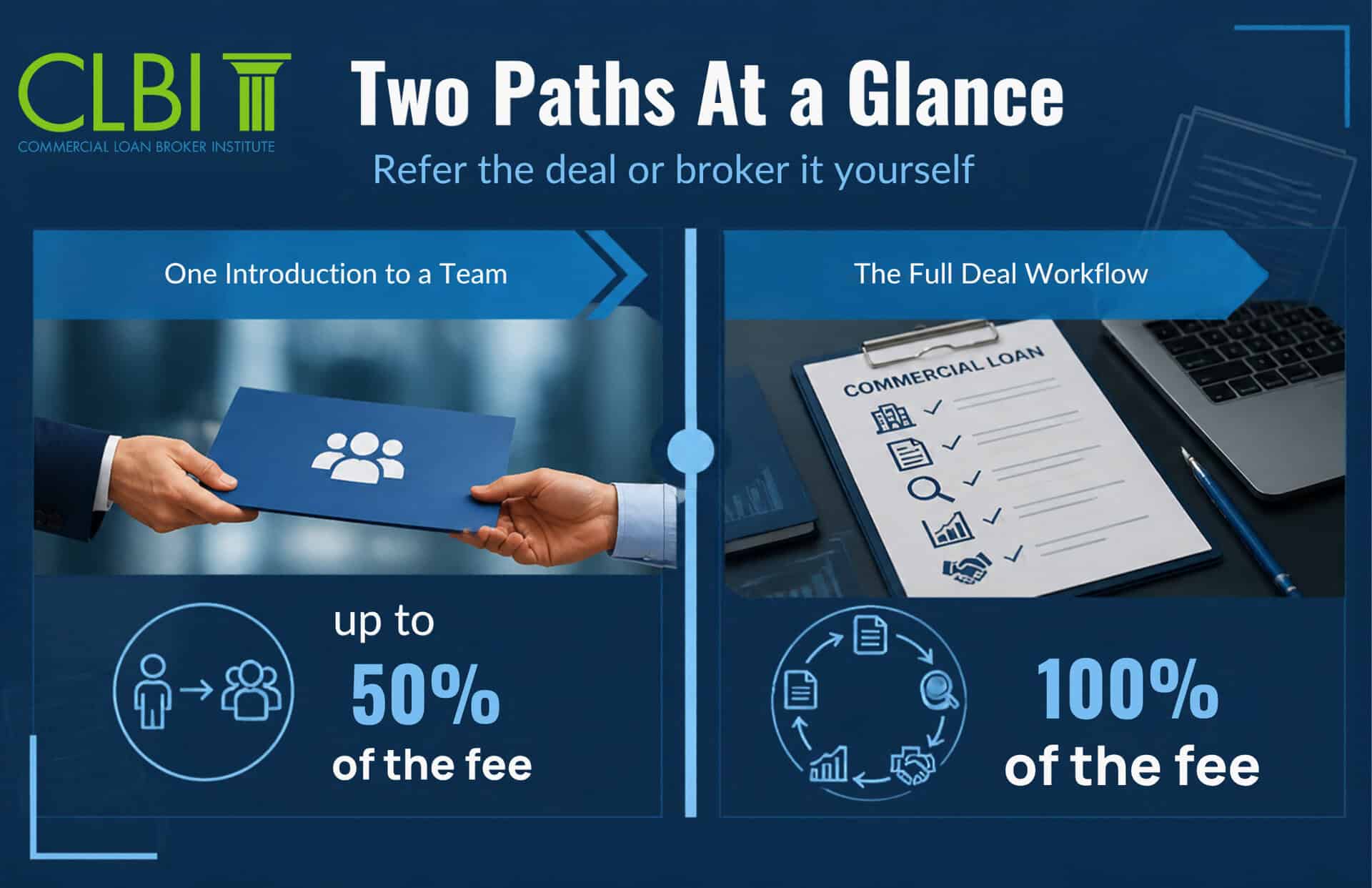
| Refer deals | Broker deals yourself | |
|---|---|---|
| Cost to start | No fee to apply or participate | An investment in training, setup, tools, and marketing |
| What you do | Make the introduction | Assess, structure, package, place, and close the deal |
| Who does the rest | Our team | You |
| What you earn | Up to 50% of the broker fee | 100% of the broker fee |
| When you’re paid | When the loan funds | When the loan funds |
| Best fit | People with relationships and a full plate already | People who want to build a full lending business |
How to Become a Business Loan Broker for Free
You don’t need to build a full brokerage to start earning in commercial lending. This video compares referring deals with brokering them yourself, and shows what the same loan pays on each path. Watch this video for the full breakdown.
How Brokers Get Paid

Brokers are usually paid when the loan funds, as a percentage of the loan. That percentage is counted in points, and one point is 1% of the loan amount. Commercial loans run large, so even one point can be a big number. That’s why an introduction to the right borrower can be worth so much.
Path 1: Refer deals through the Capital Partner Program

Who It Fits
Three kinds of people tend to do well with referrals. What they share is relationships with business owners and real estate investors who need financing.
The connector. Maybe you sell insurance, run your own business, or you’re simply the person everybody knows. People already ask you, “Do you know anybody who does loans?” Now you have an answer that pays.
The real estate agent or broker. If you work on investment or commercial properties, your buyers and developers usually need financing. You’re already in the conversation, so an introduction is a natural next step.
The advisor. CPAs, accountants, and business coaches see which of their clients are growing. Picture a CPA who sends one short email to business clients, letting them know she has a financing resource if they ever need it. One client replies. He’s under contract on a 60-unit apartment building and needs a loan to close. We’ll run the numbers on that deal below.
What happens after the introduction
- We learn the deal. Our team gets to know your contact, what they’re trying to accomplish, and what’s in the way, then lays out a financing plan.
- We structure and package it. The loan request is organized, documented, and presented in a way lenders can follow easily.
- We place it. We take the deal to lenders with an established appetite for that type of loan and work with the lender and the borrower to move it toward funding.
- You get paid. When the loan funds, the broker fee is paid, and you receive your share of it as a thank-you for the introduction.
You can stay hands-off or stay involved with your client. That’s up to you.
What You Earn
The program is free to apply for, but it’s not open for everyone. You apply, and approved partners get a portal for sending in deals. (Rules on paid referrals vary by state, and real estate agents may need to route referral fees through their managing broker, so check what applies to you.)
Path 2: Broker Deals Yourself

That path takes more skill and more setup. It’s also the one we’ve built our training around, and we’ve launched more than 500 brokerages that do exactly this.
One deal, both paths

| Refer the deal | Broker it yourself | |
|---|---|---|
| Loan amount | $8.5 million | $8.5 million |
| Broker fee (1 point) | $85,000 | $85,000 |
| Your share | 50% | 100% |
| Your payout | $42,500 | $85,000 |
| Your work | One email and one introduction | Assess, structure, package, place, and close |
That’s $42,500 for a single introduction, or $85,000 for doing the full job. Neither is wrong. It depends on how much of the work you want to take on.
This is an illustration, not a promise of income. Broker fees vary by loan type, size, and lender. Payment comes only at funding, and some referrals won’t get there. But for anyone who already knows people who borrow, referrals done consistently can become a very lucrative second income stream.
Pick your path
If you’d rather make the introduction and let a team handle the rest, apply to become a Capital Partner and start earning on the relationships you already have, at no cost.
If you want to keep the whole fee and build a lending business of your own, explore our training program to learn how to structure, package, and place deals yourself.