
A lot of people assume the finance industry has a velvet rope. A prestigious degree in finance. Years spent working at a bank. A license framed on the wall.
It doesn’t. You don’t need a finance degree or a banking pedigree to become a commercial loan broker. And in most of the country, you don’t even need a license to get started.
What you do need might be skills and resources you already have.
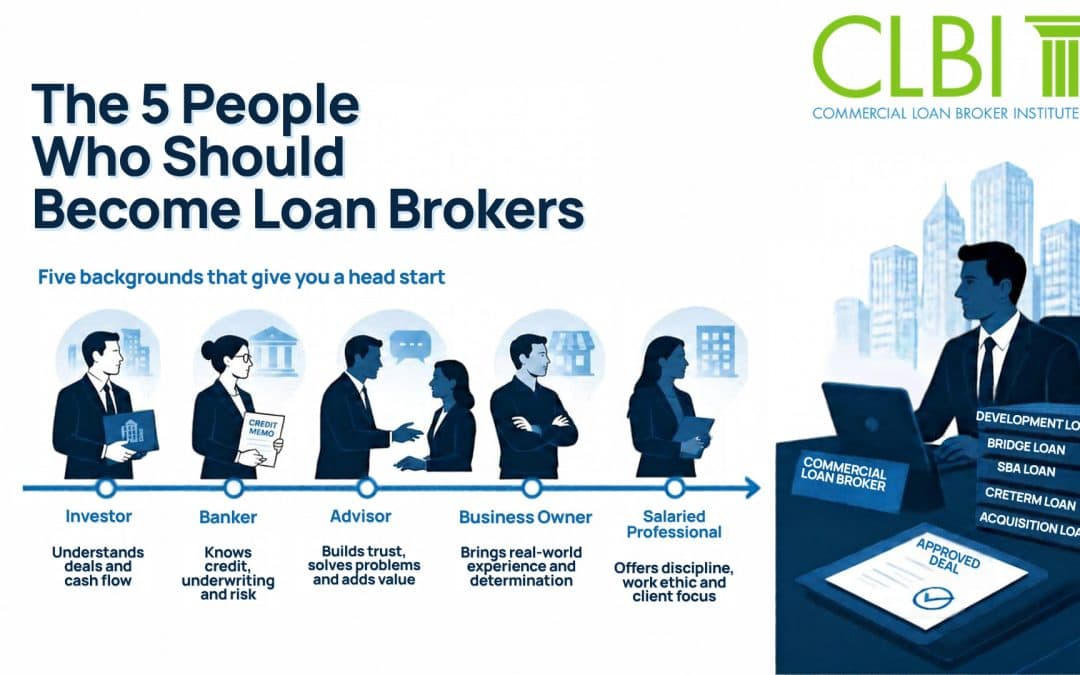
From launching hundreds of brokerages, we found there are five professional backgrounds that give people a real head start. People from these five tend to walk into the industry already a few steps ahead.
A head start isn’t a requirement, though, and it isn’t what decides who wins at the end of year one, much less year five. But it helps. So here are those five backgrounds that give you a head start.
1. Real estate investors and real estate pros

You understand properties. You understand how deals come together. And you’ve felt the pain of getting one funded firsthand. The lender stalls. The terms shift. The deal nearly dies on the table.
You also know people who need capital. You’re surrounded by them every week.
Brokering turns that knowledge and that network into income, without a dollar of your own money at risk. You’re not the investor anymore. You’re the one who gets the investor funded.
So you don’t start from zero. You start with a warm pipeline.
The 5 People Who Should Become Loan Brokers
Wondering if your background gives you a head start in commercial lending? This video walks through the five types of people who tend to thrive as loan brokers, and why drive matters more than any résumé. Watch this video for the full breakdown.
2. People who already work with money

If that’s you, you already speak finance. You understand credit. You can read financials. You know how to evaluate a business, or how a deal gets underwritten. Most beginners have to learn that from scratch. You get to skip a grade or two.
If you’re in this category, you probably also have clients with financing needs you can’t serve. Maybe it just isn’t what your shop does, so you send them away. Or you’re a banker and get credit apps that just don’t fit your credit box.
Either way, you already have access to opportunities. Lots of new brokers face lead generation as their biggest challenge. But you already have leads on your desk or in your inbox, giving you a big leg up when entering the industry
3. The trusted advisors

Business owners and investors already lean on you. They trust you with their decisions, their deals, or their books. So you’re sitting on a steady stream of people who need capital to grow, expand, or close a deal.
What happens today when one of them needs financing? You refer it out. The problem goes to someone else, and so does the revenue.
Add loan brokering and you handle it yourself. The relationship gets deeper. You become more valuable to the client. And the revenue that’s been walking out your door stays put.
4. Entrepreneurs and business owners

That experience is hard to fake. It makes you credible. Clients can tell you’ve sat in their chair, because you have.
There’s a second reason this fits. Brokering is the kind of business an operator would design for themselves. No inventory. No employees required. None of your own capital at risk. You can build it on your own, without a warehouse, a payroll, or a pile of startup cash.
5. The driven professional who’s hit a ceiling

Brokering pays per deal, not per hour. Your income grows with your effort and skill, and there’s no built-in limit on how many deals you can do.
Say you place a $1.5 million loan at 2 points. A point is 1% of the loan, so that’s $30,000 on a single transaction.
That’s just one illustration of how earnings work. Commissions typically run 1 to 10 points, and what you earn depends on the deal and the lender. One deal might pay $5,000. Another might pay $50,000. For someone stuck behind a ceiling, that changes how you think about what your work is worth.
A head start, not a requirement

Every one of these backgrounds gives you a leg up. You start with a warm network, a shared language, knowledge in business or real estate, or experience with deals.
But the biggest predictor of who thrives in this business isn’t on a résumé.
It’s personality and drive.
So if you saw yourself in one of these five, good. You’re starting a few steps ahead. Take that advantage and leverage it for all it’s worth, and that can be quite a lot in this space.
But if you read the whole list and didn’t see yourself anywhere, don’t count yourself out. We’ve watched people with none of these backgrounds become some of the best brokers in the market. They had the thing that actually matters.
It’s who you are, not where you came from.
Find out if you’re built for this
So the real question isn’t what’s on your résumé. It’s whether you’re wired for this work.
We put together a free quiz that scores you on the five personality traits that predict who succeeds as a commercial loan broker. It takes a couple of minutes. Take the quiz and find out if you’re built for commercial finance.
When you’re ready to go further, see how our commercial loan broker training program works.