

Every business loan broker gets told no. You can package a file well, send it to a lender that looks like a match, and still get a decline. You don’t control the other side of the table, and lenders have their own reasons for passing.
So the brokers who build a real book of business aren’t the ones who never hear no. They’re the ones who know exactly what to do next. A borrower hears no and assumes the deal is dead. A good broker treats it as the starting gun.
Here’s the playbook, step by step.
Step 1: Treat it as feedback, not failure
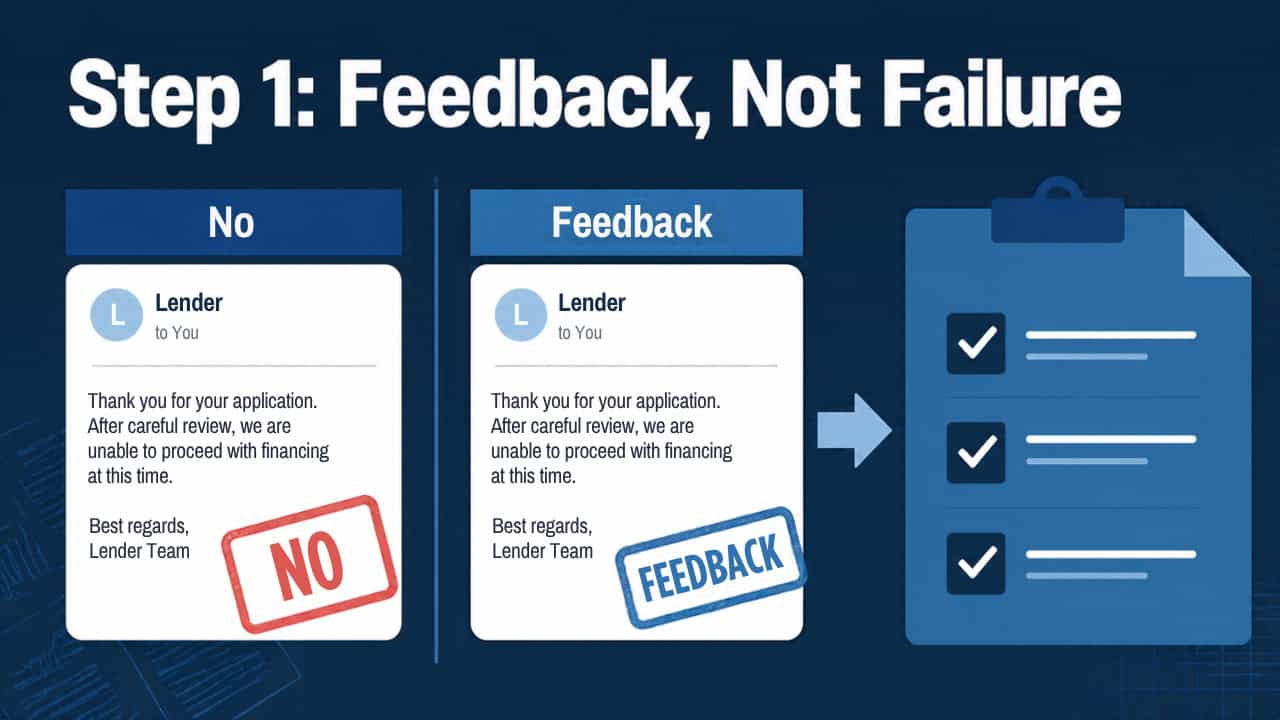
None of those thoughts help you, and most of them aren’t true. A decline is information about one lender’s view of one file at one moment. That’s all. The brokers who do well have a checklist for this moment, and they work it calmly instead of spiraling. The rest of this article is that checklist.
Step 2: Ask the open question first
So ask. Plainly. “Why isn’t it a fit? Can you tell me more?” You’re one lending professional talking to another, and it costs a credit officer almost nothing to explain. Much of the time, that one question gets you a straight answer.
Start broad on purpose. The actual problem may be one you’d never think to guess. If you lead with a narrow question, you only learn about the problems you already suspected.
Why Lenders Say No (And How Brokers Fix It)
A lender’s no is rarely the end of the deal. This video walks through the exact steps to find out why a file got declined, fix the right problem, and bring your client along with a plan. Watch this video for the full breakdown.
Step 3: If the answer is still vague, make it multiple choice

“Was it the leverage, the coverage, the industry, or the sponsor?”
Leverage is how much you’re borrowing against the value of the property or business. Coverage is whether the cash flow comfortably covers the loan payments. Industry is the type of business or property. The sponsor is the borrower and their track record. Most declines trace back to one of those four, and a lender can answer that question in one word.
The order matters. Open question first, multiple choice second. Lead with the multiple choice and you lose every reason that wasn’t on your list. Never ask at all and you lose the deal.
Step 4: Check whether the no is about the lender

None of that shows up in a decline letter. That’s how one package can be rejected in spring and approved in summer, occasionally by the very lender that turned it down. It’s also why a lender list goes stale fast. What a lender wanted last year may not be what it’s funding today.
This step protects your head as much as your deal. If you read every no as a verdict on your work, you’ll quit over things that were never about you.
Step 5: Sort the real reason into one of four buckets
| What has to change | What the lender is telling you | The fix |
|---|---|---|
| The file | There’s a gap or soft spot in the paperwork. The underlying deal works. | Fill the gaps. Add documentation, explain the soft spots, tighten the cover letter, and resubmit a stronger package. |
| The deal | The paperwork is complete, but the numbers in the request don’t work. | Restructure. More cash in, more collateral, or a smaller loan so the cash flow covers the payments comfortably. Then update the package. |
| The borrower | The business or borrower needs more time, history, liquidity or credit before anyone funds it. | Give the borrower a written to-do list with dates. Name exactly what needs to improve and by when. |
| The lender | The deal is solid. It landed on the wrong desk. | Send it to a better-fit lender, often after a few tweaks to the structure or documentation. |
Getting the bucket right is the whole game. Put a deal problem in the file bucket and you’ll spend weeks polishing documents for a lender that was never going to say yes. A business owner sitting at the kitchen table with a decline letter can’t tell these four apart. A broker can, and that’s a big part of what the borrower is paying for.
Step 6: Decide whether to go back to the same lender

When you do go back, don’t drop the file in as if it were brand new. Reach out first. Briefly explain how you addressed each concern they raised, and ask whether they’d be willing to look at the updated package. The credit officer doesn’t feel ambushed by a deal they declined last week, and you come across as a professional who listens.
A lender-fit problem is different. Skip the second try entirely. A lender’s credit box, the set of deals it’s built to fund, doesn’t move because you asked nicely. The deal goes to a different lender, which only works if you have a different lender to send it to. This is where CLBI brokers have an edge. They place through our lender network, which gives a declined file plenty of other places to land.
Step 7: Call your client with feedback, not a decline

Start with the frame. Don’t say “we got declined.” Say “we got feedback from a lender.” It’s the same event, but your client hears it very differently. “Declined” sends people into lockdown fear mode. “Feedback” keeps them open to the next step.
Then never deliver the news without the plan attached. Here’s the lender’s actual feedback. Here’s which of the four things has to change. Here’s where the file goes next and when. Borrowers rarely leave a broker over a decline. They leave when they hear nothing, or when you hand them a problem with no path through it.
Step 8: Be honest when the answer is “not yet”
Pushing that borrower into a high-cost loan just to get paid is the worst move you can make. They might qualify for far better terms in nine months. So tell them plainly. Set a target date and spell out the milestones they need to hit before you try again. You haven’t lost them. They come back ready, and they send you referrals.
Walking one deal through the playbook

A real estate investor wants to buy a mixed-use building for $2,400,000: shops on the ground floor, apartments upstairs. The building produces $180,000 a year in net operating income, which is the rent left over after operating expenses. Your borrower asks for a $1,800,000 loan, or 75% of the purchase price.
The bank passes with one line. You ask why it isn’t a fit and get something vague back. So you ask: leverage, coverage, industry or sponsor? One word comes back. Coverage.
Now run the numbers. At an illustrative 7.5% rate over 25 years, a $1,800,000 loan costs about $159,600 a year in payments. Divide $180,000 of income by $159,600 of payments and you get a debt service coverage ratio (DSCR) of about 1.13x. That means $1.13 of income for every $1.00 of loan payment. This bank wants at least 1.25x.
That’s a deal problem, not a file problem. The file was fine, and polishing it won’t change the math. The request itself has to change. So your borrower brings in a partner who adds $200,000 of equity, and the loan request drops to $1,600,000. Payments fall to about $141,900 a year, and the DSCR rises to about 1.27x. That clears the bank’s minimum.
The bank already knows the deal and the borrower, so you go back to the same lender. You send a short note explaining that the borrower took the coverage feedback seriously and restructured, and you ask if they’ll review the updated package. They do, and it funds. At 2 points, that placement pays the broker $32,000. That’s an illustration of how the economics work. Real commissions depend on the deal, the lender and the product.
Now change one detail. Suppose the answer had been, “We don’t lend on mixed-use.” That’s a lender problem. No restructuring fixes it, and going back would waste everyone’s time. The same package, unchanged, goes to a lender that does mixed-use every week.
Same playbook, same first two questions. A completely different next move, because the bucket was different.
Handling a no is a skill you can learn

Every broker gets told no. The ones who build something don’t have thicker skin or better luck. They have a process, and they run it every time: get the real reason, sort it, pick the right lender, and bring the client along with a plan.
If you want a lender network behind you and support on files like this one, see how our commercial loan broker training program works.