
If you are trying to grow a commercial loan brokerage, you have probably tried the obvious moves.
More outreach. More follow-up. More hustle. More time spent working each deal harder. That is usually where serious brokers go first, because serious brokers aren’t lazy. They are willing to make calls, chase documents, follow up with lenders, and keep deals moving.
But here is the uncomfortable truth: if your brokerage has a bottleneck, more hustle does not necessarily create more growth. Just as often, more hustle creates more pressure at the point where the system is already constrained.
That is why some brokers feel like they are constantly working harder without seeing the business actually become smoother, more predictable, or more profitable. They are not failing because they lack ambition. They are failing because they are applying effort to one part of the business while the real constraint lives somewhere else.
A brokerage grows at the speed of its weakest critical link.
That is the idea that changes the conversation.
The question is not, “How do I do more?” The better question is, “Where is my brokerage actually constrained?”
The Real Growth Problem Is Usually a Bottleneck
Every commercial loan brokerage operates like a system.
It finds opportunities in the market, qualifies them, advises the borrower, packages the file, places the deal with the right lenders, pushes the transaction toward funding, and then uses the revenue and feedback from those deals to build a stronger business.
That is the work.
But the work does not move evenly through every part of the system. Some parts are fast. Some are slow. Some are strong. Some are fragile. And one weak area can limit the throughput of the entire brokerage.
That weak area is the bottleneck.

A bottleneck is not just a problem. It is the problem limiting your next stage of growth.
Brokerages can have many imperfections at once. Your branding might need work. Your deal packaging might be messy. Your lender follow-up might be inconsistent. Your CRM might be underused. But not every issue is equally responsible for your current growth ceiling.
The art is identifying the constraint that is most limiting the business right now.
If you misdiagnose that, you waste energy. You may buy more leads when your real issue is qualification. You may study more loan products when your real issue is poor positioning. You may chase more lenders when your real issue is weak packaging.
That is why bottleneck thinking is so valuable. It forces the broker to stop treating every problem as equally urgent and start asking which constraint is actually controlling growth.
Why Your Brokerage Isn’t Growing (It’s Not What You Think)
If your brokerage has a bottleneck, more hustle only creates more pressure. This video shows you how to diagnose the exact constraint limiting your revenue and fix it. Watch this video for the full breakdown.
Technician or Business Builder?
Many brokers enter the industry as technicians. They want to understand financing. They want to know the products. They want to learn how deals are structured. That technical skill matters, and there is no shortcut around it.
But a brokerage is not just technical work. A brokerage is a business.
That means the broker has to think beyond individual transactions. The business must repeatedly attract opportunities, qualify them, advise the client, package the deal, place it with the right lender, manage the process, close the transaction, and then improve from what happened.
That is operating-system thinking.
A technician asks, “How do I solve this deal?”
A business builder asks, “How do I build a system that reliably turns the right opportunities into funded transactions?”
You need both.
A broker who is only a technician may become very good at solving problems in individual files but never build predictable deal flow or scalable operations. A broker who is only a business builder may build marketing and systems but lack the technical judgment required to protect clients and lenders.
The strongest brokers learn to combine both identities.
They understand the craft of commercial finance, but they also build a business that can acquire clients, qualify opportunities, guide borrowers, package deals, place with lenders, and scale beyond constant manual effort.
That is where the bottleneck conversation becomes useful. It gives the broker a way to diagnose the business instead of just working harder inside it.
The Broker Operating System
At CLBI we talk about the broker operating system.
At its heart is the understanding that a commercial loan brokerage is not just a collection of tasks. It is an operating system that turns market opportunities into funded deals.
That operating system has three major functions.
First, you have to win the opportunity.
This is the front end of the brokerage. It includes positioning, prospecting, qualification, and client counseling. In plain English, this is how you become visible to the right people, attract or pursue opportunities, determine whether those opportunities are worth working on, and guide the borrower toward a realistic funding strategy.
Second, you have to move the deal.
This is the execution engine. It includes packaging, placement, and pushing the deal forward. You need to tell the deal story clearly, support that story with documents, match the file to lenders whose credit boxes make sense, and keep the transaction moving without letting communication lag or momentum disappear.
Third, you have to build the firm.
This is the part many brokers postpone until the pain is unavoidable. It includes tools, standard operating procedures, team structure, and tracking. It is how the brokerage becomes more repeatable, less fragile, and less dependent on the broker personally remembering every detail in every file.
Those three functions work together.
Win the opportunity. Move the deal. Build the firm.
If any one of them is weak, growth slows.
Free Online Webinar
Learn How the Broker OS Works
in Practice
Why One Weak Link Limits the Whole Brokerage
This is the part that frustrates brokers.
You can be strong in one area and still feel stuck because the bottleneck is somewhere else.
A broker might be excellent at deal analysis but weak at lead generation. That broker understands commercial finance, but not enough qualified opportunities are entering the system.
Another broker might generate plenty of conversations but attract the wrong borrowers. That broker does not have a deal-flow problem. They have a qualification problem.
Another broker may have good borrowers but weak lender placement. In that case, the issue may not be demand. It may be lender fit, packaging, or how the deal is being positioned.
Another broker may be closing deals but living in chaos. They are working nights, weekends, and constantly reacting because the business depends too heavily on their personal effort. That is not a hustle problem. It is a systems problem.
This is why simply doing more is often the wrong prescription.
More outreach does not fix weak qualification. More lender calls do not fix poor packaging. More product knowledge does not fix lack of positioning. More late-night effort does not fix missing systems.
The right solution depends on the actual constraint. That is the purpose of bottleneck diagnosis.
The First Diagnostic Question
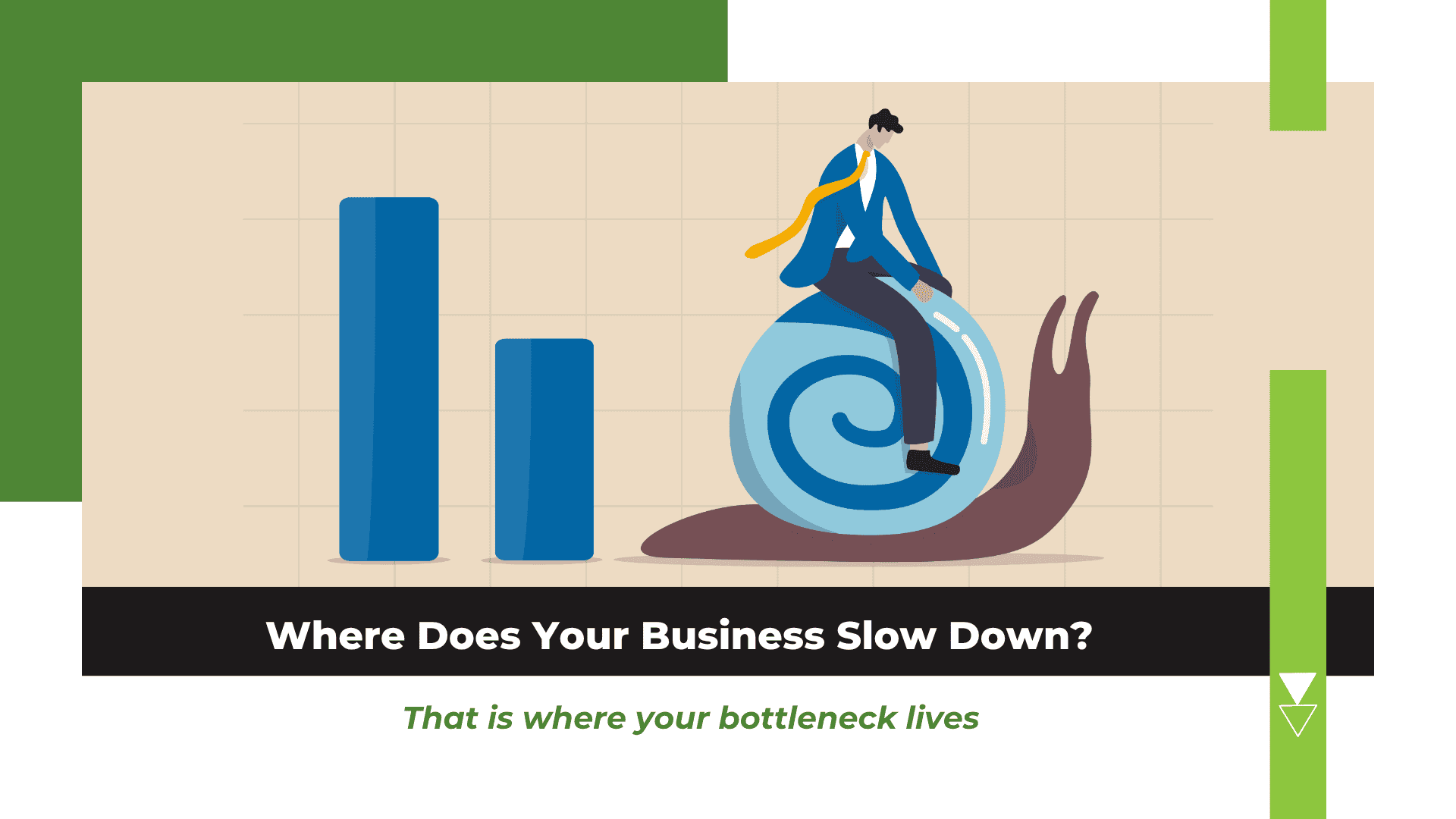
The first question is simple: Where does the business slow down?
Not where is it imperfect. Not where could it be better someday. Where does it slow down right now?
If you do not have enough real opportunities entering the pipeline, the bottleneck is probably in the “win the opportunity” function. That could mean positioning, prospecting, referral development, or market visibility.
If you have plenty of conversations but poor deal quality, the bottleneck may be qualification or client counseling. You may be attracting interest, but not the right kind. Or you may be accepting the borrower’s request too passively instead of shaping the deal into something fundable.
If you have good opportunities but weak closings, the bottleneck likely lives in the “move the deal” function. That may involve packaging, lender fit, document collection, follow-up, or deal management.
If you are closing deals but constantly overwhelmed, the bottleneck is probably in “build the firm.” You may need stronger tools, clearer SOPs, better tracking, or eventually team support.
That is the lens.
The goal is not to fix everything at once. The goal is to find the constraint that is limiting the system now.
The Better Growth Question
Most brokers ask, “How do I grow faster?”
A better question is, “What is currently preventing growth from flowing through the brokerage?”
That may sound like a subtle difference, but it changes the entire strategy.
The first question invites more effort. The second invites diagnosis.
And diagnosis is what serious businesses do.
If a brokerage is a system, then growth is not merely a function of motivation. It is a function of throughput. Deals can only move as fast as the system allows. Revenue can only become as predictable as the weakest parts of the system permit.
So before adding more pressure, identify the constraint. This is how a broker stops working harder at the wrong thing and starts fixing the part of the business that actually controls growth.
Stop Working Around the Bottleneck
CLBI’s training program gives you the systems and structure to build a brokerage that scales.
The Most Common Brokerage Bottleneck Patterns
Once you start thinking in terms of bottlenecks, the symptoms become easier to read.
A commercial loan brokerage usually does not announce its constraint directly. The bottleneck shows up through patterns. Certain problems keep repeating. Certain stages keep slowing down. Certain frustrations keep returning, even after the broker works harder.
That repetition is useful because it tells you where to look. There are several patterns we see repeatedly across brokerages, and each one points to a different constraint.
Pattern #1: Strong Knowledge, Weak Deal Flow
Some brokers know the products.
They understand SBA lending. They understand commercial real estate. They understand equipment financing, working capital, bridge loans, private credit, and lender appetite. They can talk intelligently about deal structure and financing options.
But the phone is not ringing enough.
Or, more accurately, the right conversations are not happening often enough.
This is one of the most frustrating bottlenecks because the broker may be genuinely capable. They may have the technical knowledge required to help clients, but the market does not yet see them as the person to call.
In that case, the bottleneck is not knowledge.
It is usually positioning, prospecting, or referral development.
This lives in the “win the opportunity” function of the broker operating system. If not enough good opportunities are coming in, the front end of the business needs attention. The broker may need a clearer niche, a sharper message, a stronger referral strategy, more consistent outreach, or a better way to explain the problems they solve.
More product knowledge will not fix this bottleneck.
That is the trap.
The broker keeps studying because studying feels productive. It also feels safer than going into the market and testing positioning. But at some point, more technical confidence does not create more deal flow. The business needs visibility, trust, and a practical path to qualified conversations.
A broker in this position should ask:
Who do we serve best?
What capital problems do we solve most clearly?
Who already has access to the clients we want to reach?
What message would make those people understand why we are useful?
Those are positioning and prospecting questions. And if the bottleneck is deal flow, that is where the work belongs.
Pattern #2: Good Activity, Poor Deal Quality
Another brokerage may have the opposite problem.
There is activity. There are conversations. Borrowers are asking questions. Files are coming in. The broker is busy.
But the quality is poor.
The opportunities are not realistic. Borrowers are not ready. Documents are missing. Expectations are inflated. The deals do not fit lender appetite. The broker spends a lot of time listening, explaining, gathering, and following up, but very little of that work turns into funded transactions.
This feels like a lead problem, but it is often a qualification problem.
The brokerage is allowing too many weak opportunities too far into the process.
That may happen because the broker is new and wants to help everyone. It may happen because the broker is afraid to push back. It may happen because the broker does not yet have a clear enough definition of what a fundable opportunity looks like.
Whatever the cause, the result is the same.
The pipeline gets clogged.
A clogged pipeline is dangerous because it creates the illusion of momentum. The broker sees files, conversations, and possible commissions everywhere. But if those files do not have a realistic path to funding, the pipeline is not an asset. It is unpaid labor wearing a nice jacket.
This bottleneck usually lives in qualification and counseling.
Qualification is where the broker determines whether the opportunity deserves serious time. Counseling is where the broker helps the borrower understand what must change for the deal to become fundable.
If the broker skips those steps, they become a pass-through.
They take what the borrower says they want and send it forward without enough assessment. That may feel responsive, but it usually creates friction later. Lenders push back. Borrowers get frustrated. The broker has to explain delays that could have been anticipated earlier.
A broker in this position should ask:
What makes a deal worth working on?
What information do we need before we invest serious time?
Where do borrower expectations need to be reset earlier?
Are we shaping the request, or simply forwarding it?
Those questions move the bottleneck from vague frustration into a clear operational fix.
Pattern #3: Good Opportunities, Weak Closings
Some brokers have real opportunities.
The borrowers are legitimate. The capital needs are meaningful. The deals are not imaginary. There is a plausible path to funding.
And yet, too few deals close.
This is a different bottleneck.
If good opportunities are entering the system but not reaching the finish line, the issue usually lives in the “move the deal” function. That means packaging, placement, lender communication, document collection, follow-up, or deal management.
This is where execution gets exposed.
A good opportunity can still die if it is packaged poorly. Lenders do not want to assemble the deal story from scattered documents and vague explanations. They want to understand the borrower, the use of funds, the repayment path, the collateral, the risks, and the reason the structure makes sense.
A good opportunity can also stall if it is sent to the wrong lender.
A deal can be strong in general and still be a poor fit for a specific lender’s credit box. Wrong asset type. Wrong geography. Wrong leverage. Wrong borrower profile. Wrong deal size. Wrong use of proceeds.
When lender fit is weak, the broker may interpret slow responses as lender indifference, borrower difficulty, or “the market being tight.” Sometimes those things are true. But often, the problem is simpler.
The deal was not placed correctly.
And even when the package and placement are good, deals still need to be pushed forward. Not aggressively. Not by annoying everyone involved. But by maintaining rhythm, clarity, and accountability.
Borrower documents need to move. Lender questions need answers. Conditions need tracking. Communication cannot disappear into someone’s inbox and reemerge two weeks later.
This is where many brokers need better systems.
A broker in this position should ask:
Are our packages making the deal easy to understand?
Are we matching deals to lenders with real appetite for that profile?
Do we have a follow-up rhythm that keeps deals moving?
Where exactly are strong opportunities slowing down?
The answer often reveals the true constraint.
Pattern #4: Strong Hustle, Weak Systems
This is one of the most common bottlenecks among capable brokers.
The broker is working hard. Very hard. They are calling, emailing, managing documents, talking to borrowers, following up with lenders, tracking conditions, responding to referral partners, and trying to keep every deal alive. From the outside, it looks like commitment.
But commitment without systems eventually turns into chaos.
If every deal depends on the broker’s memory, inbox, notes, personal follow-up habits, and ability to mentally hold the entire business together, the brokerage becomes fragile. It may produce revenue, but it does not scale cleanly.
This is when brokers start saying things like:
“I just need more hours in the day.”
“I have too many things moving at once.”
“I know what needs to happen, but I cannot stay ahead of it.”
“I am closing deals, but the business feels messy.”
That is not usually a motivation problem.
It is a “build the firm” problem.
The brokerage needs tools, SOPs, tracking, templates, and eventually team support. Not because systems are exciting. They are not. Nobody wakes up thrilled to build a document checklist. Well, almost nobody. There are people, and we respect their strange gift.
But systems matter because they convert personal effort into repeatable execution.
If the same document problem happens in every file, create a better intake process. If the same borrower questions keep slowing you down, create better explanatory materials. If follow-up depends entirely on memory, build a tracking rhythm. If team members cannot help because the process only exists in your head, create SOPs.
A broker in this position should ask:
What problems repeat across files?
What tasks depend too heavily on me personally?
What needs to be documented so someone else can eventually help?
Where does the business become chaotic when volume increases?
Those questions point directly to the system bottleneck.
Pattern #5: Feast-and-Famine Revenue
Feast-and-famine cycles are especially frustrating because the broker may be good at multiple parts of the business.
They can generate opportunities. They can serve borrowers. They can move deals. They can close transactions.
But they cannot do all of it at once consistently.
So the cycle begins.
The broker markets aggressively and fills the pipeline. Then the broker gets busy working deals. Marketing slows down. Prospecting fades. Referral partner follow-up gets delayed. The broker focuses on closing what is in front of them.
Then the deals close. Revenue comes in. And the pipeline is empty.
Now the broker has to restart the front end of the business, but there is a lag before new opportunities become funded deals. This creates the familiar emotional swing: busy, relieved, worried, frantic, busy again.
This bottleneck often points to the third part of the broker operating system: building the firm.
The issue is not that the broker cannot win opportunities. The issue is that winning opportunities and moving deals both depend too heavily on the same person at the same time.
The broker does not yet have enough systemization, delegation, automation, tracking, or team support to keep the machine running consistently.
A broker in this position should ask:
What stops when I get busy?
Which activities create future pipeline but disappear during active deal work?
What could be systemized, scheduled, delegated, or templated?
What would allow marketing and deal execution to run at the same time?
Those questions point directly to the system bottleneck.
The Bottleneck Diagnostic: What Is Actually Limiting Growth?
At this point, the central idea should be clear. Your brokerage is not limited by how hard you are willing to work. It is limited by the weakest critical component in the system.
That does not mean effort is irrelevant. Effort matters. Follow-up matters. Responsiveness matters. There is no version of commercial loan brokerage where discipline stops being important. But effort only compounds when it is applied to the right constraint.
If the real bottleneck is poor positioning, more deal packaging will not fix it.
If the real bottleneck is weak qualification, more lead flow may only create a larger pile of low-quality files.
If the real bottleneck is lender fit, working the same mismatched deals harder will not magically create funding.
If the real bottleneck is lack of systems, more hustle may close a few deals but make the brokerage more chaotic every time volume increases.
That is why the diagnostic matters.
The goal is to identify the place where improvement would unlock the most capacity.
Not the easiest problem or the most familiar problem. The limiting problem.
Start With the Three-Part Broker OS
The easiest way to diagnose your brokerage is to come back to the three-part operating system:
Win the opportunity.
Move the deal.
Build the firm.
Every bottleneck belongs somewhere inside that structure. So to make this practical, take out a piece of paper and divide it into three sections.
At the top of the first section, write: Win the Opportunity.
Then ask yourself: are enough of the right opportunities entering the brokerage?
Not just opportunities. The right opportunities.
If the answer is no, write down the likely cause. Is your positioning too broad? Are you unclear about who you serve? Are referral partners unsure when to send people to you? Are you doing inconsistent outreach? Are you attracting borrowers who are not realistic or not ready?
This first section is where many brokerages discover that their issue is not technical skill. It is market clarity.
At the top of the second section, write: Move the Deal.
Then ask yourself: when a good opportunity enters the pipeline, does it move cleanly toward funding?
If the answer is no, look deeper. Are you telling the deal story clearly? Are documents being collected efficiently? Are you matching the file to lenders that actually want that profile? Are lender questions being answered quickly? Are borrowers receiving clear expectations at the right time?
This section exposes execution gaps.
At the top of the third section, write: Build the Firm.
Then ask yourself: can the brokerage handle more volume without becoming more chaotic?
If the answer is no, the issue is probably not effort. It is infrastructure.
Do you have repeatable processes? Do you have templates? Do you have tracking? Do you have a clear way to know where each deal stands? Do you have standard operating procedures that someone else could eventually follow?
This section exposes scalability gaps.
The point of the exercise is not to create a perfect business plan in one sitting. It is to identify the current constraint. Once you see it, the next step becomes much clearer.
Where Structured Support Fits
This is where structured support can make the path much cleaner.
At the Commercial Loan Broker Institute, we do not view brokerage growth as one-dimensional. Product knowledge matters, but it is not the whole business. Lender access matters, but it is not the whole business. Marketing matters, but it is not the whole business.
A brokerage grows when the components work together.
That is why our programs are built around the broader operating system: helping brokers understand the business model, develop the knowledge to assess and structure deals, access lender relationships, use tools and resources that make execution cleaner, and receive coaching that helps them avoid predictable mistakes.
The goal is not to replace the broker’s effort.
The goal is to make that effort more effective.
If a broker is stuck at the front end, support may help clarify positioning, prospecting, and qualification. If a broker is stuck in deal execution, support may help with packaging, lender fit, and process. If a broker is stuck in chaos, support may help create the systems and operating discipline needed to scale.
The right support should not create dependency. It should increase capability.
The Final Question to Ask
If you take only one thing from this article, make it this question:
Where is my brokerage actually constrained right now?
Not where could it improve someday.
Not what feels most frustrating.
Not what someone else said you should fix.
Where is the actual bottleneck?

If you answer that clearly, the next step becomes more obvious. You stop throwing effort everywhere. You stop assuming hustle is the strategy. You stop treating symptoms as if they are the root problem.
Instead, you start working on the constraint.
Find the bottleneck. Fix the bottleneck. Then find the next one.
That is how a brokerage stops surviving from deal to deal and starts becoming a business that can actually scale.